


In aviation, uniforms carry more weight than in most industries.
They represent authority, safety, and brand identity—all at once. For airlines and airport operations across the Kingdom, the expectations around aviation uniforms in Saudi Arabia go far beyond appearance. Every garment must balance visual precision with real-world functionality.
Because in aviation, a uniform is not just seen. It’s relied upon.
1. First Impressions Start Before the Flight

For passengers, the journey begins at the airport—not on the aircraft.
Ground staff, check-in teams, and cabin crew form the first point of contact. Their appearance sets the tone for the entire experience. This is why airlines invest heavily in airline staff uniforms in KSA that reflect their positioning:
- Structured silhouettes that communicate authority
- Clean lines that maintain a polished appearance throughout long shifts
- Consistency across roles and locations
In premium aviation brands, uniforms are part of the identity—not an afterthought.
2. Functionality Is Non-Negotiable
While appearance matters, aviation is an operationally demanding environment.
Cabin crew, ground staff, and technical teams require uniforms that support movement, flexibility, and long working hours. Leading uniform suppliers in Saudi Arabia are expected to deliver:
- Lightweight, breathable fabrics for comfort during extended shifts
- Stretch and flexibility for ease of movement in confined spaces
- Materials that maintain structure despite continuous use
For cabin crew especially, uniforms must perform across multiple conditions—from airport environments to in-flight service.
3. Climate Demands Smarter Fabric Choices
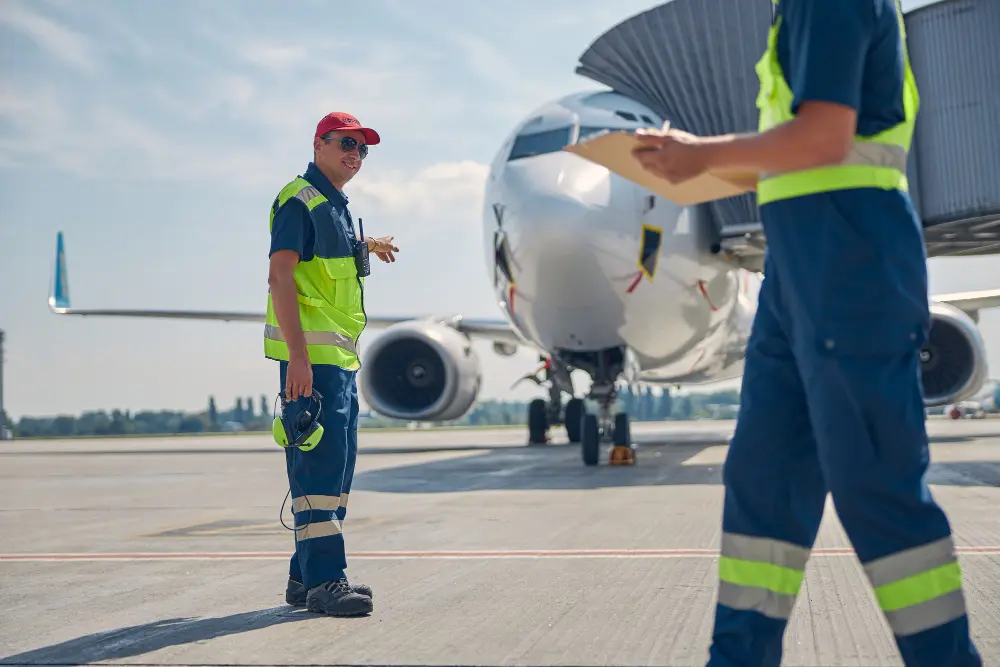
Saudi Arabia’s climate adds another layer of complexity.
Uniforms must handle:
- High outdoor temperatures during ground operations
- Controlled indoor environments inside terminals and aircraft
- Long hours without compromising comfort
This is where breathable workwear for hot climates becomes critical. Airlines increasingly prioritise fabrics that regulate temperature and reduce discomfort—without affecting the overall look of the uniform.
A well-designed uniform in aviation is one that adapts, not one that restricts.
4. Role-Specific Design Matters
Not all aviation roles require the same uniform approach.
Airlines and airport operators expect clear differentiation between:
- Cabin crew uniforms suppliers in KSA delivering refined, brand-led designs
- Airport ground staff uniforms in Saudi Arabia focused on durability and visibility
- Technical teams requiring more functional, performance-driven workwear
Each role has its own requirements, and uniform design must reflect that.
A generic approach leads to inefficiencies—both in performance and perception.
5. Durability Under Continuous Use
Aviation uniforms go through constant wear.
Frequent travel cycles, long shifts, and repeated washing mean that durability is critical. Procurement teams assess:
- Fabric resilience over time
- Color consistency after multiple washes
- Ability to maintain structure and fit
Reliable corporate uniforms in Saudi Arabia for aviation must hold their appearance across months of use—not just at the time of delivery.
Durability directly impacts replacement cycles and operational costs.
6. Precision in Branding and Detailing

In aviation, small details are highly visible.
Uniforms are expected to maintain:
- Accurate logo placement and embroidery
- Consistent color tones across garments
- Clean finishing and construction
This is why airlines work with experienced custom uniforms in Saudi Arabia providers who can deliver precision at scale.
Any inconsistency—no matter how small—affects the perception of the brand.
7. Standardisation Across Fleets and Locations
Airlines operate across cities, regions, and international routes.
Uniforms must remain consistent across all touchpoints:
- Airports within Saudi Arabia
- International destinations
- Different teams within the same airline
This requires suppliers who can manage large workforce uniform solutions while maintaining uniformity across production batches.
Standardisation is not just about appearance—it ensures that the brand remains recognisable everywhere.
8. Supply Chain and Timelines Are Critical
Uniform programs in aviation cannot afford delays.
Airlines require:
- Structured rollout timelines
- Reliable reordering systems
- Fast turnaround for new hires
Strong uniform supply chain management in KSA ensures continuity, especially in an industry where staffing levels fluctuate frequently.
Delays in uniform supply can disrupt operations and affect service readiness.
9. Evolving Expectations in Aviation Uniforms
The aviation industry in Saudi Arabia is growing rapidly, with increasing focus on:
- Premium passenger experience
- Global brand positioning
- Operational efficiency
Uniforms are evolving alongside these changes.
Airlines are now looking for corporate uniform solutions in Saudi Arabia that combine:
- Design expertise
- Fabric innovation
- Scalable supply systems
The expectation is no longer just supply—it’s partnership.
Closing Perspective
Aviation uniforms sit at a unique intersection.
They must communicate authority, support performance, and maintain consistency across one of the most demanding operational environments.
In Saudi Arabia, where aviation continues to expand, the role of uniforms is becoming even more critical.
