
How Housekeeping Uniform Requirements Differ From Front Office Uniforms in Hotels
When guests think about hotel uniforms, they often picture reception teams, concierge staff, or guest relations personnel.
Behind the scenes, however, housekeeping teams represent one of the largest uniformed departments within most hotels. While both housekeeping and front office employees contribute to the guest experience, their day-to-day responsibilities differ—and their uniforms should reflect that.
Yet many hospitality businesses still apply similar design principles to both categories.
This often leads to uniforms that look appropriate on paper but create challenges in daily operations.
For hotels investing in hospitality uniforms in Saudi Arabia, understanding the difference between housekeeping and front office requirements is essential when building an effective uniform program.
Front Office Uniforms Are Built Around Guest Interaction

Front office employees spend much of their shift in highly visible guest-facing environments.
Reception teams, concierge staff, guest relations executives, and lobby personnel are often the first people guests interact with upon arrival.
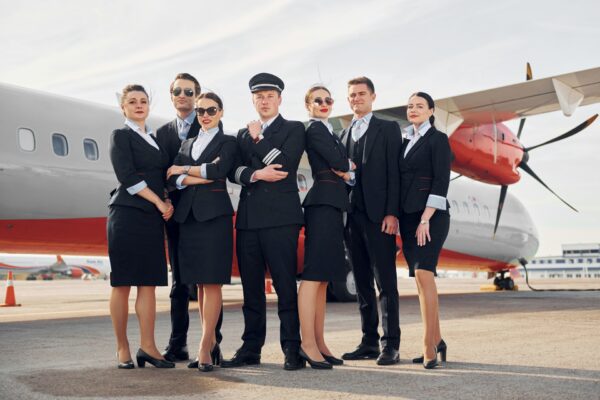
As a result, front office uniforms for hotels are typically designed with a strong emphasis on presentation.
Hotels often prioritise:
- Structured silhouettes
- Brand-aligned colour palettes
- Tailored appearance
- Consistent visual identity across guest-facing departments
These uniforms contribute directly to how guests perceive the property.
Appearance matters because front office staff represent the hotel brand throughout every interaction.
Housekeeping Uniforms Are Built Around Movement
Housekeeping teams operate under very different conditions.
A typical shift may involve:
- Preparing multiple rooms
- Pushing housekeeping carts
- Lifting linens
- Reaching, bending, and stretching repeatedly
- Walking significant distances throughout the property
Because of this, housekeeping uniforms in KSA must prioritise functionality before appearance.
This does not mean appearance is unimportant. It means the design process starts with operational requirements.
Uniforms that restrict movement can quickly affect productivity and employee comfort.
Fabric Requirements Are Not the Same
One of the biggest differences between these departments is fabric performance.
For front office teams, fabrics are often selected based on:
- Appearance retention
- Structure
- Professional presentation
- Comfort during long periods of standing
For housekeeping teams, priorities shift toward:
- Durability
- Flexibility
- Ease of movement
- Frequent washing performance
Housekeeping uniforms generally experience greater physical wear than front office uniforms.
This is why fabric selection should be approached differently for each department.
Replacement Cycles Are Usually Different
Many hotel operators notice that housekeeping uniforms require replacement more frequently than front office garments.
There are practical reasons for this.
Housekeeping uniforms are exposed to:
- More physical activity
- Greater friction during daily tasks
- More frequent laundering
- Cleaning products and chemicals
As a result, replacement cycles are often shorter.
Understanding these differences helps procurement teams make more accurate decisions regarding inventory planning and budgeting.
This is one reason experienced hospitality uniform suppliers in Saudi Arabia often recommend separate garment specifications for different departments.
Colour Selection Requires Different Considerations
Front office uniforms are often strongly influenced by brand identity.
Hotels may select colours that align closely with:
- Interior design themes
- Corporate branding
- Guest experience objectives
Housekeeping uniforms require a slightly different approach.
Colour selection must also consider:
- Practical maintenance requirements
- Stain visibility
- Frequency of washing
- Long-term appearance retention
The same colour palette may not perform equally well across both departments.
Fit Requirements Vary Significantly
A front office employee typically spends much of the day:
- Standing
- Assisting guests
- Working at reception desks
Housekeeping teams operate in far more physically demanding environments.
Their uniforms need to accommodate:
- Repetitive movement
- Lifting tasks
- Room preparation activities
- Continuous mobility throughout shifts
This often requires:
- Different garment construction
- Greater ease through key movement areas
- Alternative fit specifications
Applying the same fit strategy across both departments rarely delivers the best result.
Laundry Performance Plays a Larger Role for Housekeeping Teams
Hotels place significant emphasis on uniform appearance.
However, how garments perform after repeated laundering is just as important.
Housekeeping uniforms often undergo:
- Frequent washing
- High-volume commercial laundering
- More intensive usage cycles
For this reason, durability, colour retention, and fabric recovery become major considerations.
A uniform that performs well during initial fittings may behave very differently after months of industrial laundering.
Both Departments Contribute to Guest Perception
Although housekeeping teams are less visible than front office staff, their uniforms still influence the guest experience.
Guests frequently encounter housekeeping personnel in:
- Corridors
- Guest floors
- Public areas
- Service interactions
A consistent, professional appearance remains important across all departments.
The difference is that housekeeping uniforms must achieve this while supporting a more physically demanding workload.
The Best Hotel Uniform Programs Recognise These Differences

Hotels often achieve better long-term results when they stop viewing uniforms as a single category.
Instead, they develop role-specific solutions based on how each department operates.
This allows businesses to:
- Improve employee comfort
- Reduce replacement frequency
- Support operational efficiency
- Maintain consistent brand presentation
For large hospitality operations, these differences become increasingly important as teams grow and uniform programs become more complex.
Conclusion
Front office and housekeeping teams may work within the same hotel, but their uniform requirements are fundamentally different.
One department is built around visibility and guest interaction.
The other is built around movement, durability, and operational performance.
Recognising these differences early allows hotels to create uniform programs that work better for employees, support daily operations, and maintain professional standards across every department.
FAQs
1. Does AttireCorp develop separate uniform solutions for housekeeping and front office teams?
Yes. AttireCorp designs department-specific hospitality uniforms based on operational requirements, employee responsibilities, and working environments rather than applying a single uniform standard across all hotel departments.
2. Can AttireCorp recommend different fabrics for housekeeping and reception staff?
Yes. Fabric recommendations are made according to how garments will be used. Housekeeping teams typically require different durability and movement characteristics than guest-facing front office personnel.
3. How does AttireCorp help hotels manage uniform consistency across multiple departments?
AttireCorp develops structured hospitality uniform programs that maintain brand consistency while allowing individual departments to have garments tailored to their specific operational needs.
4. Can AttireCorp support large hotel openings and multi-property hospitality projects?
Yes. AttireCorp supports hospitality projects ranging from new hotel launches to large multi-property rollouts, including design development, sizing, production, quality control, and distribution planning.
5. Why do hotels choose AttireCorp for hospitality uniform projects in Saudi Arabia?
Hotels work with AttireCorp because of its ability to combine hospitality industry knowledge, fabric expertise, custom design capabilities, and large-scale production management into a complete uniform solution.
